
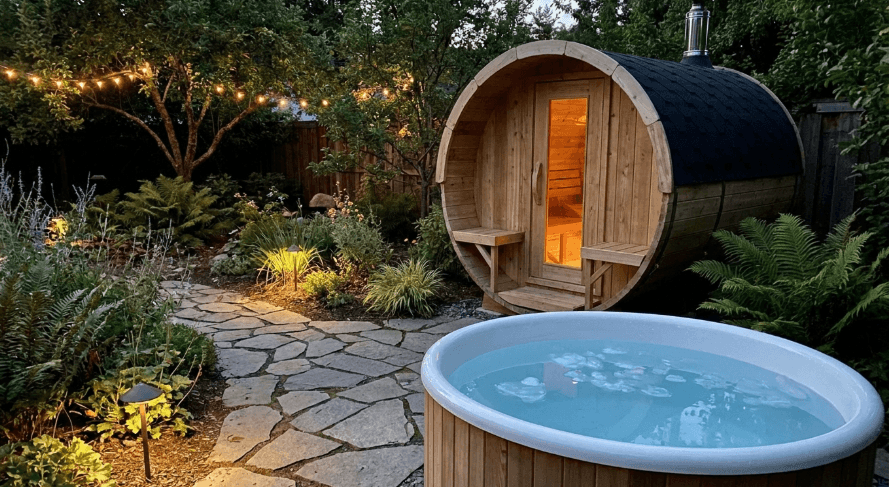
A DIY kit saves roughly $500 to $2,500 in labor if you’re comfortable with basic carpentry and can hire an electrician for the final hookup. A full professional install costs more up front but removes the risk of a failed inspection, a leaking roof seam, or wiring that voids the heater’s warranty. The right call depends on your skill level, your local permitting rules, and whether the unit is hardwired or plug-in.
What actually comes in a DIY sauna kit?
A typical barrel or cabin kit ships as pre-cut wall panels, a floor frame, a roof section, a bench kit, and the heater with its stone tray. Basswood and cedar kits from mainstream manufacturers are numbered and pre-drilled, which cuts the guesswork compared to building from raw lumber. Assembly time for a 4 to 6 person cabin runs 8 to 16 hours for two people working a weekend. A barrel sauna, with its curved staves and steel cradle, tends to go together faster once the cradle is leveled, since the staves self-align under the tension bands.
Where DIY saves the most money
Labor is the biggest line item a kit removes. A contractor-built cabin sauna with framing, insulation, cedar paneling, and bench work can run $3,000 to $6,000 in labor alone on top of materials. Assembling a kit yourself keeps that number closer to zero, minus tool rental and any helper you bring in for a day. The tradeoff is time and the learning curve on details like keeping a consistent vapor barrier behind the interior paneling, which matters more in a sauna than in a normal room because of the heat and humidity cycling.
Where a pro install earns its cost
Electrical work is the clearest case for hiring out. A hardwired 6kW or 8kW heater needs a dedicated 240V circuit, correctly sized breaker, and in many jurisdictions a permit and inspection. Get this wrong and you risk a tripped breaker under load, a fire hazard, or a voided heater warranty, since most manufacturers require licensed installation on hardwired units. Foundation work is the second case. A barrel sauna needs a level base and usually a gravel or paver pad for drainage; a garage or basement cabin install needs a floor that can handle sustained heat and moisture without the subfloor degrading over years of use.
How much does each route cost in total?
For a mid-size cabin sauna, a DIY build with a plug-in infrared heater lands around $2,200 to $3,800 total, mostly the kit itself plus a weekend of your own labor. The same footprint with a hardwired traditional heater and a licensed electrician for the final hookup runs $3,000 to $5,000. A fully professional install, where a contractor handles assembly, wiring, and any pad or subfloor prep, typically lands at $5,500 to $9,000 depending on region and access to the site. Retailers such as Sweat Decks list both kit-only and fully installed options side by side, which makes it easier to compare the sticker price of each route before you settle on one.
Which skill level fits a DIY build?
If you’ve framed a wall, hung drywall, or built a deck, a cabin or barrel kit is within reach. The steps that trip up first-timers are keeping panel seams tight enough to hold heat, sealing the roof against runoff on an outdoor barrel unit, and leaving the manufacturer’s specified clearance around the heater guard. None of these require specialty tools, just patience and a level. If you’ve never done basic framing or you’re not confident pulling a permit and scheduling an inspection yourself, a pro install removes that friction for a price.
Tools and a realistic weekend timeline
A basic tool kit covers most kit assemblies: a cordless drill with driver bits, a rubber mallet, a 4-foot level, a stud finder if you’re bracing a wall-mounted cabin, and a caulk gun for sealing exterior seams on an outdoor barrel unit. Barrel kits also need the steel tension bands supplied with the kit, or a ratchet strap as backup, to draw the curved staves tight against the cradle before the roof goes on, a step that’s awkward without a second person holding tension while you tighten the hardware. Budget Saturday morning to Sunday afternoon for a two-person cabin build: roughly 3 to 4 hours for the floor and wall panels, 2 to 3 hours for the roof and door, and another hour or two for benches and trim. A barrel sauna often goes faster once the cradle is leveled, since the curved staves self-align under the tension bands, typically 6 to 8 hours total spread across a weekend.
Mistakes that turn a DIY build into a costly redo
The most common error is skipping the vapor barrier behind interior paneling, or leaving gaps in it around the heater cutout, which lets humidity into the wall cavity and can cause hidden mold within a season or two. A close second is under-tightening a barrel’s tension bands, which leaves gaps between staves that widen further once the wood dries and shrinks slightly under repeated heat cycling. Setting a cabin directly on bare dirt or an unlevel patio without a proper pad is the third recurring mistake, since even a small lean puts uneven stress on door hinges and panel seams over time. Each of these costs more to fix after the fact, in wasted materials and redone labor, than it would have taken to get right during the original build.
Does regular use make the labor investment worth it?
Independent reviews of sauna bathing research point to health associations tied mainly to frequency, not to how the unit was installed. A 2018 review in Mayo Clinic Proceedings found regular sauna use, several sessions a week, associated with lower cardiovascular event rates in long-term cohort data. That means the installation method matters less than making sure the finished sauna is comfortable and convenient enough that it actually gets used three or four times a week rather than sitting idle after the first month.
A simple way to decide
Add up your comfort level with basic tools, whether your unit is hardwired or plug-in, and your local permit rules. Plug-in infrared cabins are the easiest DIY case since there’s no electrical work beyond an outlet. Hardwired traditional units are the split case: DIY the carpentry, hire the electrician. Outdoor barrel saunas needing a poured or graded pad are the case most likely to justify a pro for at least the site prep, even if you assemble the barrel yourself.
Frequently Asked Questions
Can one person assemble a barrel sauna kit alone?
Not comfortably. Staves and roof panels are heavy and awkward to align solo, so plan on two people for a weekend build.
Do I need a permit for a plug-in infrared cabin?
Usually not, since it runs on a standard 120V outlet. A hardwired 240V unit almost always needs a permit and inspection.
How much does professional installation typically add?
Labor for a straightforward placement runs $500 to $1,500. A dedicated circuit or poured pad pushes the total toward $2,000 to $4,000.
Is DIY actually cheaper long term?
Usually, but only if the wiring, clearances, and vapor barrier are done right the first time. A failed inspection or hidden moisture problem erases the savings.
What’s worth paying a pro for even on a DIY build?
The electrical hookup on a hardwired heater. A licensed electrician keeps the warranty and your insurance coverage intact.
References
- Benefits and risks of sauna bathing (The American Journal of Medicine, 2001)
- Effects of heat and cold on health, with special reference to Finnish sauna bathing (American Journal of Physiology, 2018)
- Cardiovascular and Other Health Benefits of Sauna Bathing: A Review of the Evidence (Mayo Clinic Proceedings, 2018)